

Main Blog Article Content
1 MIN. READ
Certificates of deposit, or CDs, are a staple for many financial portfolios. With this personal finance product, you can save money and strengthen your savings over time with guaranteed solid returns.
Click to download the infographic: Certificate of Deposit 101: Understanding the Basics.
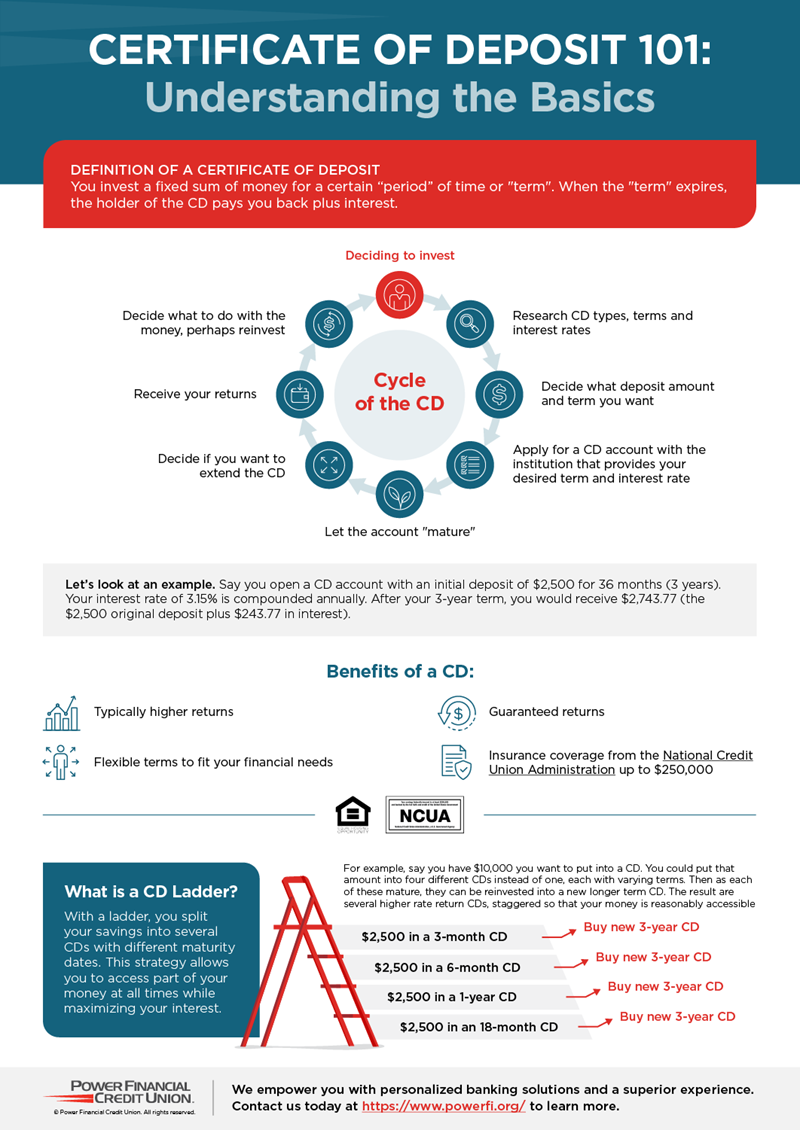
For example, say you have $10,000 you want to put into a CD. You could put that amount into four different CDs instead of one, each with varying terms. Then as each of these mature, they can be reinvested into a new longer term CD. The results are several higher rate return CDs, staggered so that your money is reasonably accessible.
We empower you with personalized banking solutions with a superior experience. Contact us today at https://www.powerfi.org/ to learn more.
Certificates of deposit, or CDs, are a staple for many financial portfolios. With this personal finance product, you can save money and strengthen your savings over time with guaranteed solid returns.
Click to download the infographic: Certificate of Deposit 101: Understanding the Basics.
CERTIFICATE OF DEPOSIT 101: Understanding the Basics
DEFINITION OF A CERTIFICATE OF DEPOSIT
You invest a fixed sum of money for a certain “period” of time or “term”. When the “term” expires, the holder of the CD pays you back plus interest.
Deciding to invest
- Research CD types, terms and interest rates
- Decide what deposit amount and term you want
- Apply for a CD account with the institution that provides your desired term and interest rate
- Let the account “mature”
- Decide if you want to extend the CD
- Receive your returns
- Decide what to do with the money, perhaps reinvest
Benefits of a CD:
- Typically higher returns
- Guaranteed returns
- Flexible terms to fit your financial needs
- Insurance coverage from the National Credit Union Administration up to $250,000
What is a CD Ladder?
With a ladder, you split your savings into several CDs with different maturity date. This strategy allows you to access part of your money at all times while maximizing your interest.For example, say you have $10,000 you want to put into a CD. You could put that amount into four different CDs instead of one, each with varying terms. Then as each of these mature, they can be reinvested into a new longer term CD. The results are several higher rate return CDs, staggered so that your money is reasonably accessible.
- $2,500 in a 3-month CD — Buy new 3-year CD
- $2,500 in a 6-month CD — Buy new 3-year CD
- $2,500 in a 1-year CD — Buy new 3-year CD
- $2,500 in an 18-month CD — Buy new 3-year CD
We empower you with personalized banking solutions with a superior experience. Contact us today at https://www.powerfi.org/ to learn more.